

Platform

Shopify Plus Development

The fastest route to an enterprise storefront your team can run without a platform team behind it. We build, migrate and extend Shopify Plus — checkout, B2B, international and headless when it earns its cost.

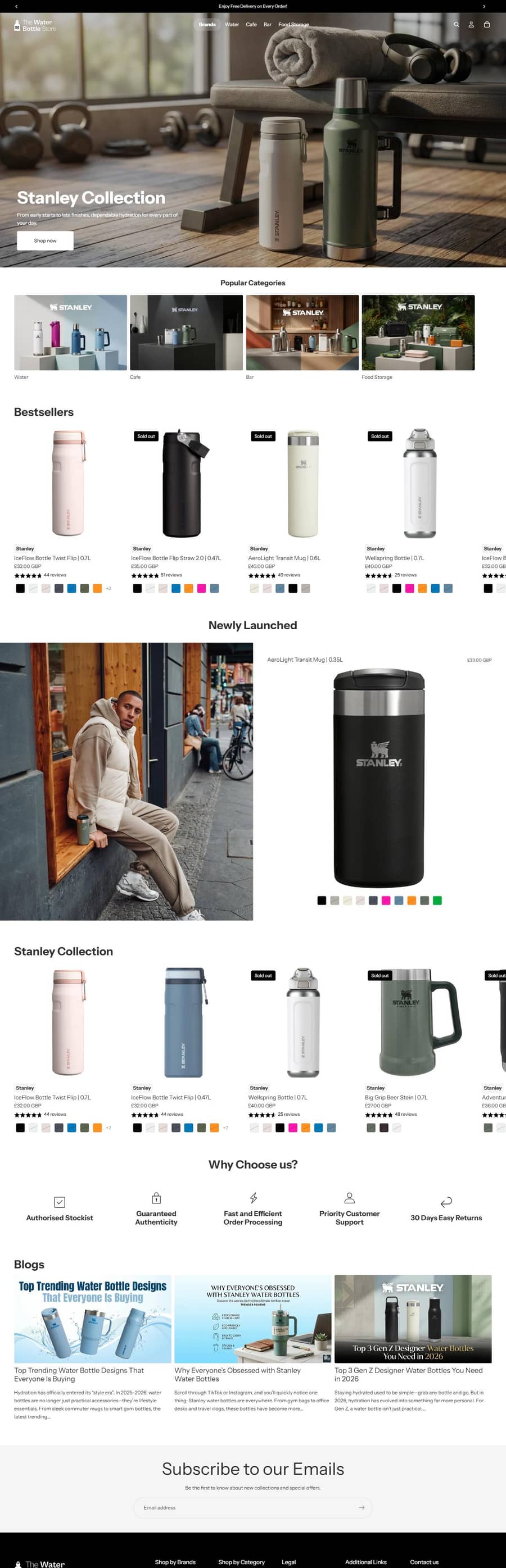
The Water Bottle Store homepage, a multi-brand Shopify storefront
The same storefront on a phone

A multi-brand Shopify storefront, where the work that mattered was search, product pages and post-purchase. Read the case study

Where it fits

Where Shopify Plus fits

Shopify Plus wins when speed and a low cost of running the store matter more than bespoke platform logic.

  1. Speed to market matters

    Shopify hosts, secures and upgrades the platform, so a build is spent on the storefront and integrations rather than on infrastructure.

  2. Your team runs the store

    Merchandisers and marketers work in the admin without a developer for every change, which keeps the cost of running it low.

  3. D2C with a growing B2B line

    B2B on Shopify covers company accounts, catalogues, price lists and payment terms in the same store, without a second platform.

  4. Selling into several markets

    Shopify Markets handles currencies, languages and domains per region from one store rather than a store per country.

Shopify Plus at a glance

Best for
Brands that want speed to launch and a store their own team can run
Hosting
Fully hosted SaaS; Shopify runs infrastructure, security and upgrades
B2B
Built-in B2B features on Plus: company accounts, catalogues, price lists, payment terms
Headless
Hydrogen framework and Oxygen hosting, over the Storefront API
Pricing model
Monthly subscription, with a variable fee that scales with revenue

Our view

Why brands move to Shopify Plus

Most of the brands we speak to are not leaving their current platform for features. They are leaving because running it takes too much: upgrades that need a project, hosting that needs watching, and a backlog that only developers can clear.

Shopify Plus moves that operational weight to Shopify. The trade is less control over the platform itself — and for most D2C brands and growing B2B lines, that is a trade worth making. Where it is not, Adobe Commerce or Salesforce Commerce Cloud usually is.

What a good build looks like

Fast before it is clever. Few apps, each earning its place. Checkout logic in extensions rather than workarounds, and a theme your team can merchandise without filing a ticket.

That is the standard we build to, whether the store is new or a rebuild of one you already have. Often the money is in the store you already have — see conversion rate optimisation before assuming a rebuild is the answer.

Capabilities

What we do on Shopify Plus

From a first build to the tenth release after it, on the same platform and with the same team.

  • Custom theme builds

    Online Store 2.0 themes built around your catalogue and merchandising, not adapted from a template that fights them.

  • Migration to Shopify Plus

    From Magento, WooCommerce, BigCommerce and custom stacks, with products, customers, orders and redirects carried across.

  • Checkout extensibility

    Checkout UI extensions and Shopify Functions for discount, delivery and payment logic, built the upgrade-safe way.

  • B2B on Shopify

    Company profiles, catalogues, price lists, payment terms and quick order, configured for how your trade customers buy.

  • Apps and integrations

    ERP, OMS, PIM and 3PL connections, plus custom apps where the App Store has nothing that fits.

  • Headless with Hydrogen

    React storefronts on Hydrogen and Oxygen when a theme genuinely cannot deliver the frontend you need.

  • Performance and Core Web Vitals

    App bloat, script weight and image delivery audited and fixed, so the store stays fast after launch.

  • Ongoing support

    Fixes, new features and conversion work after launch, from the team that built the store.

A theme is not a compromise

Enterprise brands often assume they need headless to look and perform like an enterprise brand. Most do not. A well-built Online Store 2.0 theme with lean apps and checkout extensions delivers the same commercial result at a fraction of the running cost — and when Hydrogen is genuinely worth it, we will say so.

Talk through your build

Services

What we deliver on Shopify Plus

The same services run across our platforms. These are the ones Shopify Plus projects most often need.

Compare

How the platforms compare

The right platform depends on where your complexity sits, not on a feature list. This is the short version of the conversation we have in discovery.

Criterion Shopify PlusThis page BigCommerce Adobe Commerce Salesforce Commerce Cloud commercetools
Best for Brands that want speed to launch and a store their own team can runB2B and B2C on one hosted platform, several storefronts and open APIsComplex catalogues, contract pricing and deep ERP couplingRetailers and B2B sellers whose business already runs on SalesforceMulti-brand and multi-region models, and requirements no single suite fits
Hosting Fully hosted SaaS; Shopify runs infrastructure, security and upgradesFully hosted SaaS; BigCommerce runs infrastructure, security and upgradesAdobe-managed cloud or self-hosted, with more of the stack in your controlFully hosted SaaS, run by SalesforceVendor-run cloud SaaS; you host the frontend and any services you add
B2B Built-in B2B features on Plus: company accounts, catalogues, price lists, payment termsB2B Edition: company accounts, buyer roles, quotes, price lists and buyer portalNative B2B module: company accounts, shared catalogues, quotes and approvalsSeparate B2B Commerce product, on the same CRM dataB2B in the core APIs: business units, buyer roles, quotes and approvals
Headless Hydrogen framework and Oxygen hosting, over the Storefront APICatalyst (Next.js) storefront or any frontend on the GraphQL Storefront APIGraphQL and REST APIs for a decoupled frontendCommerce API with the PWA Kit composable storefrontAPI-first by design: the storefront is always a separate frontend
Pricing model Monthly subscription, with a variable fee that scales with revenueCore, Growth and Scale plans tiered by annual sales; Performance priced by agreementAnnual licence, typically tiered by revenueTypically a share of gross merchandise valueAnnual subscription, typically linked to order volume or GMV

Vendor pricing and plan features change. Confirm current commercial terms with the vendor before you decide.

How it runs

How a Shopify Plus project runs

  1. Discovery

    Catalogue, apps, integrations and URL structure mapped first, so the scope reflects the systems the store depends on rather than the page count.

  2. Design

    Templates designed around your merchandising and your best-converting journeys, and signed off before build starts.

  3. Build and integrate

    Theme, checkout extensions and integrations built in parallel against a staging store you can review throughout.

  4. Launch and support

    Data migration, redirects and a monitored cutover, then ongoing support from the same team.

Clients

In their words

  • The CommerceBolt (Perigeon) team is exceptionally detail-oriented and aligns closely with the client's vision. They approached our project with a fresh perspective, openly embracing our requirements. The result? A robust eCommerce store that exceeded our expectations and brought our vision to life.

    Willem B. Netherlands-based agriculture company
  • I've been working with CommerceBolt (Perigeon) for our wellness store, starting with a small feature set, which has now grown into an extensive, full-featured store. We're extremely pleased with the service and support provided by CommerceBolt — truly a great team to work with!

    Paul M. Florida-based pharmacy chain

Frequently asked questions

Do we need Shopify Plus, or will a standard Shopify plan do?

It depends on what you need from checkout, B2B and scale. Plus adds checkout customisation through extensibility, native B2B features, additional expansion stores and higher API limits. If you need none of those, a lower plan may be enough, and we will say so in discovery. Plan features and pricing change, so confirm the current terms with Shopify.

Can you migrate us to Shopify Plus without losing search rankings?

Protecting rankings is planned in from the start: a URL map and 301 redirect for every product, collection and content page, metadata carried across, and search performance monitored after launch. Most traffic lost in a migration comes from missing redirects, which is a planning problem rather than a platform one.

What happened to checkout.liquid?

Shopify has retired checkout.liquid in favour of checkout extensibility — checkout UI extensions, Shopify Functions and web pixels. Customisations built the old way have to be rebuilt as extensions. We audit what your checkout does today and rebuild it in the upgrade-safe form.

Should we go headless on Shopify?

Only if a theme genuinely cannot deliver the frontend you need. Hydrogen gives you full control of the storefront but adds a separate codebase and deployment pipeline. Our Hydrogen & Oxygen page sets out when that trade is worth making.

Do you support stores you did not build?

Yes. Support usually starts with a short audit of the theme, apps and integrations, so we know what we are taking on before we commit to response times.

Planning a Shopify Plus build or migration?

Tell us where it hurts. We will tell you honestly whether we are the right people for it.

Talk to an expert Book 30 minutes