
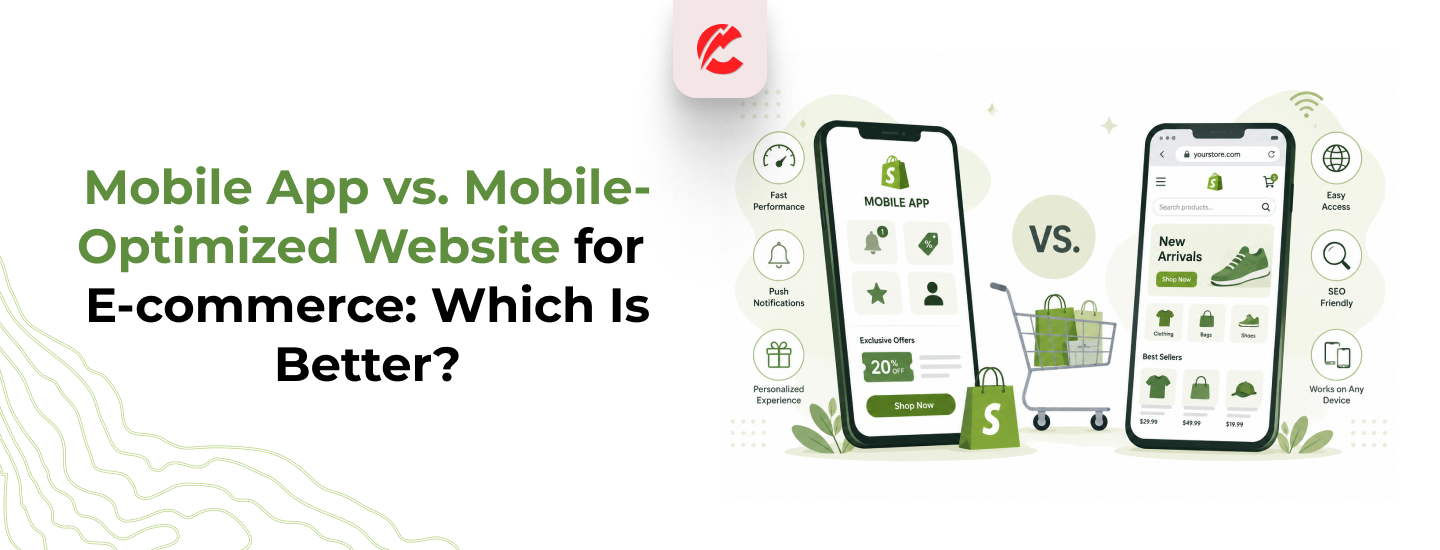
Mobile commerce now drives the majority of ecommerce traffic, making mobile experience one of the biggest factors affecting sales and customer retention. Yet many store owners face the same question:
Should I invest in a mobile app or focus on a mobile-optimized website?
The answer depends on your business size, customer behavior, budget, and growth goals.
While mobile apps often generate stronger customer loyalty and repeat purchases, mobile websites remain the most effective channel for customer acquisition through search engines and social media. For many businesses, the smartest strategy isn’t choosing one over the other—it’s knowing when each makes sense.
In this guide, you’ll learn:
- Key differences between mobile apps and mobile websites
- Cost and maintenance comparison
- SEO and conversion impact
- When to choose an app
- When a mobile website is enough
- Whether a Progressive Web App (PWA) is a better alternative
What Is a Mobile-Optimized Website?
A mobile-optimized website is an ecommerce site designed to work seamlessly across smartphones, tablets, and desktops.
Features include:
- Responsive layouts
- Fast page loading
- Mobile-friendly navigation
- Touch-friendly buttons
- Optimized checkout experience
- Cross-device compatibility
Unlike apps, users can access the website instantly without downloading anything.
What Is an eCommerce Mobile App?
An ecommerce mobile app is a dedicated application installed on a smartphone through app stores.
Apps provide:
- Faster interactions
- Push notifications
- Personalized recommendations
- Offline capabilities
- Access to device features
- Loyalty program integration
Because apps are installed directly on the device, they create a stronger connection between customers and brands. Many growing online stores work with providers offering eCommerce mobile app development services to create customized shopping experiences that improve customer engagement and retention.
Mobile App vs Mobile-Optimized Website: Quick Comparison
Why Mobile Websites Win for Customer Acquisition
If your business depends on:
| Feature | Mobile App | Mobile-Optimized Website |
|---|---|---|
| SEO Visibility | ❌ No | ✅ Yes |
| Google Ranking | ❌ No | ✅ Yes |
| Installation Required | ✅ Yes | ❌ No |
| Accessibility | Limited | Universal |
| Development Cost | High | Lower |
| Maintenance Cost | High | Lower |
| Push Notifications | ✅ Yes | Limited |
| Offline Access | ✅ Yes | Limited |
| Conversion for Loyal Users | Higher | Moderate |
| Customer Acquisition | Moderate | Excellent |
| Updates | App Store Approval | Instant |
| Time to Launch | Longer | Faster |
- Organic traffic
- Google rankings
- Content marketing
- Social media traffic
- New customer acquisition
Then a mobile-optimized website is essential.
Search engines index websites, not mobile apps. This means every product page, category page, blog article, and landing page can generate organic traffic.
Example
A customer searches:
“best wireless earbuds under $100”
Your optimized product page can rank on Google and attract visitors.
A mobile app cannot achieve this visibility.
Why Mobile Apps Win for Customer Retention
Once customers already know your brand, apps become extremely powerful.
Benefits include:
Push Notifications
Send:
- Flash sale alerts
- Abandoned cart reminders
- New product launches
- Loyalty rewards
Faster Checkout
Apps can save:
- Addresses
- Payment methods
- Preferences
Reducing checkout friction significantly.
Better Personalization
Apps track customer behavior more effectively than browsers, allowing:
- Product recommendations
- Personalized offers
- Loyalty experiences
Development Cost Comparison
One of the biggest mistakes ecommerce businesses make is launching an app too early.
Mobile Website Cost
Typical investment:
- Lower upfront development
- Single codebase
- Easier updates
- Faster deployment
Mobile App Cost
Typical investment:
- iOS development
- Android development
- App store publishing
- Ongoing maintenance
- Security updates
- Version compatibility management
Apps usually require significantly more resources than websites.
SEO Impact: App vs Website
Mobile Website
Advantages:
- Indexable by Google
- Generates backlinks
- Appears in search results
- Supports content marketing
- Builds long-term organic traffic
Mobile App
Limitations:
- Not fully searchable through Google
- Depends on app store discovery
- Requires separate ASO strategy
For SEO-focused businesses, a website is non-negotiable.
Which Converts Better?
This is where many articles oversimplify.
The truth:
Apps convert better for existing customers.
Websites convert better for first-time visitors.
Industry comparisons show app users often convert at higher rates because they already trust the brand and have completed the installation step. Meanwhile, most first purchases still begin on the mobile web.
Customer Journey Example
Stage 1
Google Search → Website
Stage 2
First Purchase → Website
Stage 3
Repeat Purchase → App
This is the model used by many successful ecommerce brands.
When Your eCommerce Business Needs a Mobile Website
Choose a mobile-optimized website if:
✅ You’re a startup
✅ SEO is important
✅ Budget is limited
✅ Most customers are new visitors
✅ You rely on Google traffic
✅ You want faster deployment
For most small and mid-sized stores, this should be the first investment.
When Your eCommerce Business Needs a Mobile App
Consider an app when:
✅ You have repeat customers
✅ Strong brand recognition
✅ Loyalty programs
✅ Frequent purchases
✅ Subscription model
✅ Large customer base
Apps make the most sense when retention becomes more important than discovery.
The Middle Ground: Progressive Web Apps (PWAs)
A Progressive Web App combines benefits from both worlds.
Users can:
- Access via browser
- Add to home screen
- Experience app-like performance
- Receive some notification support
- Avoid app-store downloads
For many growing ecommerce brands, a PWA offers an excellent balance between cost and functionality.
Decision Framework: What Should You Choose?
Choose a Mobile Website If:
- Monthly traffic under 100,000 visitors
- SEO drives revenue
- Budget is limited
- You need quick deployment
Choose a Mobile App If:
- Repeat purchases exceed 40%
- Strong loyalty program exists
- Large customer database
- Retention is your primary goal
Choose Both If:
- Established ecommerce brand
- High traffic volume
- Strong mobile customer base
- Multi-channel growth strategy
Common Mistakes Businesses Make
Building an App Before Validating Demand
Many businesses invest heavily in apps before achieving meaningful repeat purchases.
Ignoring Mobile Website Performance
Even brands with successful apps still depend on websites for discovery and acquisition.
Forgetting SEO
Without organic traffic, customer acquisition costs often increase dramatically.
Not Measuring Retention Metrics
An app only makes sense if customers actually return frequently.
Final Verdict
For most ecommerce businesses, the best strategy is:
Start with a high-performance mobile-optimized website.
Build strong SEO visibility, attract customers through Google, and optimize conversions first.
Once repeat purchases become a major revenue driver, invest in a mobile app to improve retention, personalization, and customer lifetime value.