
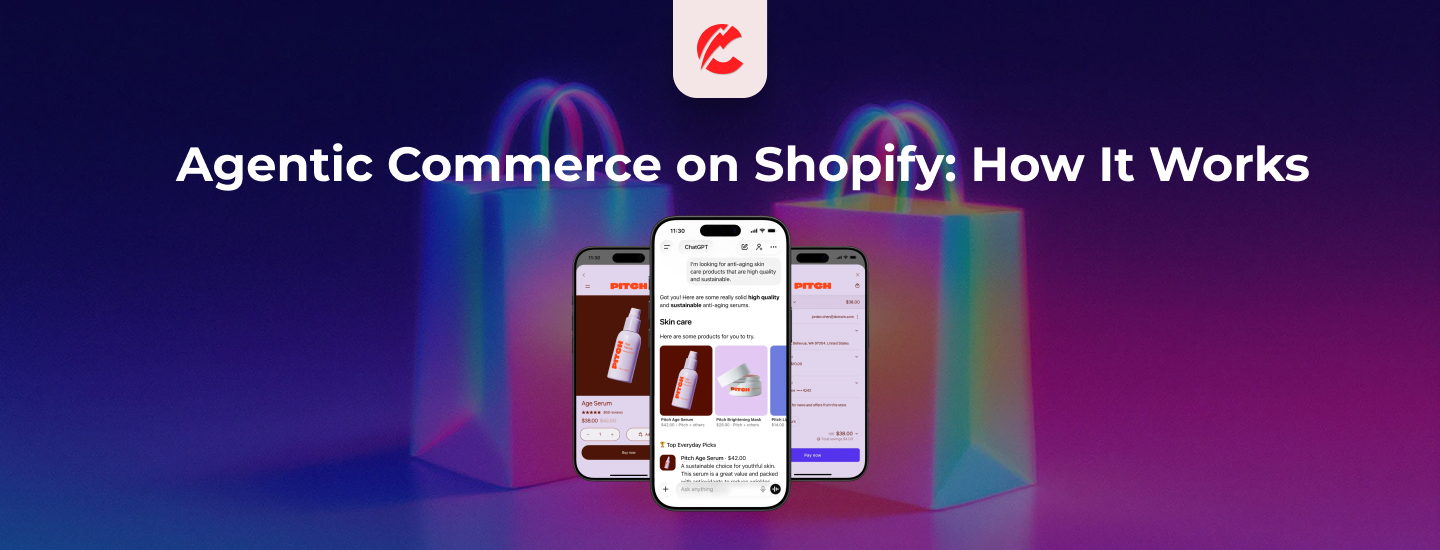
A growing share of shoppers no longer start by typing a query into Google or opening a store’s homepage. They open ChatGPT, Copilot, or Gemini and describe what they want in plain language. The AI does the searching, comparing, and narrowing down, and in a fast-growing number of cases, it can complete the purchase too.
This is agentic commerce: AI agents that help shoppers discover, compare, and buy products inside a conversation, rather than across a series of separate site visits.
The scale of the shift
Shopify reports that AI-driven traffic to its stores has grown 8x year over year since early 2025, while orders placed through AI-powered search have grown roughly 13–15x in the same period. Merchants on Shopify are now discoverable inside ChatGPT, Microsoft Copilot, AI Mode in Google Search, and the Gemini app — reaching shoppers exactly where they’re already asking for recommendations.
Getting a product recommended is only the first half of the problem. Someone still has to confirm the price is current, check that the item is in stock, calculate tax, run the payment, catch the fraud, and get the order fulfilled. That is the unglamorous, infrastructure-heavy part of commerce that takes most platforms years to get right, and it is exactly what determines whether agentic commerce actually works for a given merchant or just sounds good in a press release.
Below is a breakdown of the system underneath it, piece by piece.
How agentic commerce works, step by step
In a traditional online store, a shopper identifies a need, searches, browses a few options, and checks out. In agentic commerce, an AI agent absorbs some or all of those middle steps.
Picture someone typing into a chat: “I need a birthday gift for a 10-year-old who’s into art, budget under $30.” The agent searches connected product catalogs, filters by the stated budget and interest, and returns a short list. The shopper can push back — “show me something that ships in two days” — and the agent narrows further. When they’re ready, the purchase completes either inside the chat itself or through a lightweight in-app browser, without a separate trip to the merchant’s website.
Four systems work together behind that exchange:
-
Structured product data reaches the AI agent. Titles, descriptions, images, pricing, inventory, and shipping details are standardized and pushed to every connected AI platform in close to real time, so the agent is working from current information instead of an old, scraped snapshot of the page.
-
The agent matches that data to the shopper’s question. Depending on the platform, ranking can factor in how complete the product data is, relevance to the query, current availability and price, and how often similar listings convert.
-
Checkout runs through the merchant’s existing commerce infrastructure. Whether the buyer completes the purchase via an in-app browser or an embedded checkout inside the AI platform, the same backend handles payment processing, tax, fraud checks, and fulfillment that already runs the merchant’s normal storefront. Exactly how much of a merchant’s custom checkout logic carries over depends on the platform.
-
The order lands back in the merchant’s own admin. Attribution shows which AI channel drove the sale, and the merchant stays the merchant of record — they keep the customer relationship and the data, not the AI platform.
Why this needs a shared protocol, not a pile of one-off integrations
Every AI platform handles product discovery and checkout a little differently. Without a common standard, a merchant (or the agency building for them) would need a separate, custom integration for each one, with its own cart logic and its own payment handling — and that work would have to be redone every time a new AI platform showed up.
The Universal Commerce Protocol (UCP), co-developed by Shopify and Google, solves that specific problem. It is an open standard — not exclusive to Shopify — that defines how AI agents and merchants exchange cart, checkout, payment, and post-purchase data, regardless of which platform or payment processor is involved. UCP has backing from Amazon, Meta, Microsoft, Salesforce, Stripe, Etsy, Target, American Express, Mastercard, Visa, and Walmart, among others.
The practical upshot: a merchant’s discount rules, checkout terms, and customizations behave consistently no matter which AI agent initiates the interaction. When a new AI platform adopts UCP, merchants already built on it don’t need a fresh integration to be ready there.
Why product data quality decides what an AI agent recommends
AI agents don’t browse a storefront the way a person does. They read structured data — titles, descriptions, images, price, inventory, shipping speed — and use that to decide what to surface. Thin or messy product data doesn’t just rank worse in the agent’s results; it can get skipped over entirely.
Shopify Catalog is the structured-data layer that makes this work at scale. It standardizes product listings into a common taxonomy, keeps pricing and inventory verified in close to real time, and syndicates that data automatically to every connected AI platform. Eligible Shopify merchants are included by default — no manual feed to maintain, and updates made in admin propagate out automatically.
The conversion gap is real
Shopify reports that AI searches powered by Catalog convert at roughly 2x the rate of AI searches relying on scraped data. The difference comes down to data completeness and accuracy, not a smarter algorithm — which means the lever every merchant actually controls is the quality of their own product copy.
Catalog also infers attributes a merchant may never have explicitly tagged. A candle filed only under “home decor” might still surface for “Mother’s Day gift” searches based on purchase pattern signals, not manual categorization. This is the substance behind what’s increasingly called generative engine optimization (GEO): optimizing product data for AI agents that retrieve and recommend in response to natural-language questions, the same way SEO optimizes for traditional search crawlers. The components are familiar — data completeness, structured formatting, trust signals like accurate live pricing, and engagement signals like conversion rate — they’re just aimed at a different reader.
For stores outside the Shopify ecosystem, there’s no automatic equivalent of Catalog doing this work in the background. That’s where schema markup (Product, Offer, Organization), clean structured taxonomy, and verified real-time pricing have to be built and maintained deliberately rather than inherited for free.
Where the actual selling happens: AI shopping channels
Catalog gets a product noticed. A separate layer determines whether the sale can complete inside the AI conversation itself or has to redirect somewhere else — and that varies meaningfully by platform.
- ChatGPT (OpenAI): Live for eligible merchants selling to US buyers. The buyer completes checkout through an in-app browser pointed at the merchant’s own storefront.
- Microsoft Copilot: Eligible merchants can offer direct, embedded checkout inside Copilot itself, powered by UCP — no redirect required.
- AI Mode in Google Search and the Gemini app: Rolling out to select US-based merchants selling to US buyers, with native UCP-powered checkout, and broader availability expanding over time.
Across every channel, the merchant stays merchant of record. The customer relationship, the order data, and the attribution showing which AI surface drove the sale all flow back to the merchant’s own systems — the AI platform is a discovery and conversion surface, not a new owner of the customer.
For merchants on Shopify, most of this is genuinely on by default, with a toggle in admin to turn direct checkout on or off per channel where that choice applies. For merchants on other platforms, the equivalent outcome — being reliably discoverable and transactable inside an AI conversation — has to be engineered rather than switched on, which is where platform-specific schema, feed structure, and checkout architecture decisions actually matter.
Controlling what an AI agent says about your brand
An AI agent can read a store’s About page or FAQ section, but reading isn’t the same as understanding correctly. Ambiguous policy language, outdated return windows, or vague shipping promises get summarized confidently and sometimes wrong — and a shopper who gets a bad answer about returns or shipping from an AI agent rarely circles back to double-check on the actual site. The sale is just gone, with the merchant never seeing why.
The fix is giving agents verified, structured answers to draw from instead of an inference: documented return policies, shipping terms, and brand voice guidelines that an AI tool can cite directly rather than guess at. Shopify ships this as a dedicated Knowledge Base layer for its merchants. Stores on other platforms can achieve the same outcome with a well-structured FAQPage schema and a maintained, explicit policy page — the mechanism differs, but the requirement (give the agent a verified source of truth, not a page to interpret) is the same regardless of platform.
Selling through AI channels without being on Shopify
Shopify Catalog, Agentic Storefronts, and Knowledge Base are native to the Shopify platform. But the underlying demand — shoppers asking AI agents for product recommendations — doesn’t stop at the edge of Shopify’s merchant base.
Shopify’s Agentic plan is built specifically for businesses running on other platforms — BigCommerce, WooCommerce, a custom ERP-backed storefront, whatever the existing stack is — to sync their product data into Shopify Catalog and become discoverable and transactable across AI channels without a full replatform. It sits alongside an existing commerce stack rather than replacing it, with no flat subscription fee; the cost is standard payment processing rates on transactions that actually complete through it.
That is a meaningful detail for any BigCommerce or WooCommerce merchant who has been told the only way into agentic commerce is migrating platforms. It is not. UCP itself is an open standard, not a Shopify-exclusive mechanism, and Shopify’s own sidecar plan is explicit proof that the company expects merchants to keep their existing platform and still want into this channel.
What this actually means if you run a store
None of the above requires ripping out your platform and starting over. For most merchants, regardless of platform, the practical starting point is the same short list:
- Clean, complete product data — titles, descriptions, every variant attribute, current pricing and inventory
- Structured data and schema markup (Product, Offer, Organization, FAQPage) validated against Google’s Rich Results Test
- A documented, unambiguous policy and FAQ source an AI agent can cite accurately instead of guessing
- Analytics set up to actually attribute AI-channel traffic and orders, instead of letting it disappear into “direct”
- On Shopify specifically: confirming Catalog eligibility and reviewing Agentic Storefronts settings in admin
Where CommerceBolt fits in
This is exactly the kind of audit we run for clients before recommending any platform change: a clear read on whether your current product data, schema, and checkout setup are actually ready for AI-driven discovery, on Shopify, BigCommerce, or WooCommerce alike — and a concrete list of what to fix first if they’re not.
Get in touch for a free consultation, or explore our eCommerce development services to see how we approach platform and storefront work.
Frequently Asked Questions (FAQs)