
Launching a fashion brand today is easier than ever—but building a successful online store is more challenging. Customers expect fast-loading websites, beautiful product pages, seamless mobile shopping, flexible payment options, and hassle-free returns. The eCommerce platform you choose directly impacts all of these experiences.
Whether you’re starting a clothing label, scaling a direct-to-consumer (D2C) fashion brand, or managing an established apparel business, selecting the right platform can influence your growth, operational efficiency, and long-term profitability. Partnering with an experienced eCommerce development company can also help you choose and implement the right platform based on your business goals.
This guide compares the best eCommerce platforms for fashion brands, explains their strengths and limitations, and helps you determine which solution best fits your business goals.
Why Choosing the Right eCommerce Platform Matters for Fashion Brands
Fashion businesses have unique requirements that go beyond selling standard products. A typical fashion store may offer multiple sizes, colors, fabrics, collections, and seasonal inventories. Managing these efficiently requires an eCommerce platform designed for flexibility and scalability.
An ideal platform should support:
- Product variants such as size, color, and style
- High-quality images and videos
- Fast mobile shopping experiences
- Inventory management across multiple channels
- SEO-friendly product pages
- Personalized shopping experiences
- Secure and flexible payment methods
- Easy returns and exchange workflows
Choosing a platform that supports these needs helps improve customer satisfaction while reducing operational complexity. If you’re building a new online store, consider working with custom eCommerce development experts to create a shopping experience tailored to your brand.
Key Factors to Consider Before Choosing an eCommerce Platform
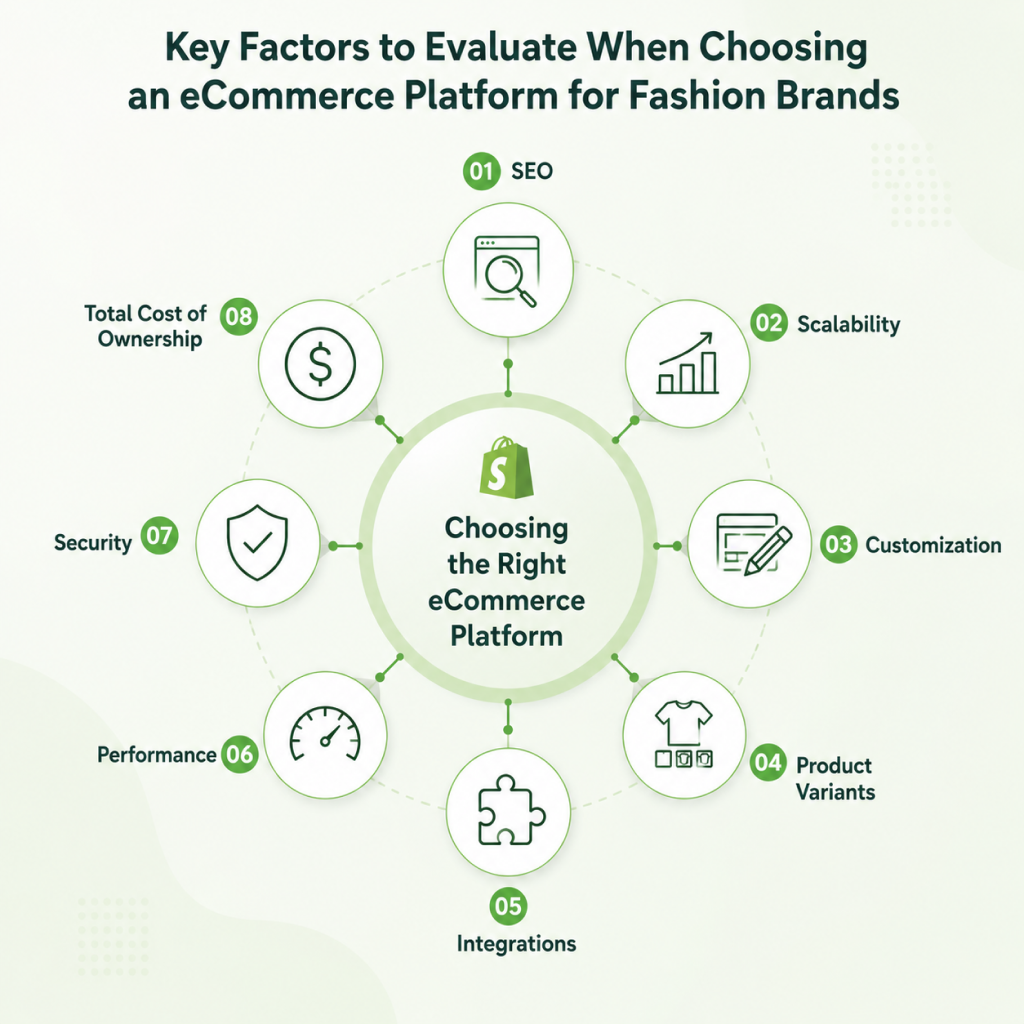
Before comparing platforms, evaluate your business against these criteria.
1. Scalability
Can the platform handle growth as your catalog expands, traffic increases, and sales grow? If you expect rapid expansion, investing in scalable eCommerce solutions can save significant migration costs in the future.
2. Ease of Management
Your team should be able to manage products, pricing, promotions, and inventory without unnecessary technical complexity.
3. SEO Capabilities
Look for features such as:
- Custom URLs
- Meta titles and descriptions
- Schema markup
- Fast loading speeds
- Mobile optimization
- Clean site architecture
Strong SEO helps fashion brands attract organic traffic and reduce dependence on paid advertising. Combining the right platform with eCommerce SEO services can further improve your search visibility.
4. Customization
Every fashion brand has its own identity. The platform should allow you to create a unique shopping experience without limiting your design or functionality. Businesses that need advanced functionality often choose custom eCommerce website development for complete flexibility.
5. Integrations
Consider compatibility with:
- ERP systems
- CRM software
- Marketing automation
- Email platforms
- Payment gateways
- Shipping providers
- Social commerce channels
Proper integrations are easier to implement with experienced eCommerce integration services.
6. Total Cost of Ownership
Don’t focus only on subscription fees. Consider development, hosting, maintenance, premium apps, and ongoing support when calculating your long-term investment.
Best eCommerce Platforms for Fashion Brands
Shopify
Best for: Growing D2C fashion brands and startups
Shopify is one of the most popular eCommerce platforms for fashion businesses because it offers an excellent balance of simplicity, scalability, and performance. If you’re planning to build your store on Shopify, professional Shopify development services can help you launch faster and customize your storefront.
Pros
- Easy to launch and manage
- Excellent mobile shopping experience
- Large app ecosystem
- Fast and secure hosting
- Strong multi-channel selling capabilities
- Wide selection of professionally designed themes
Cons
- Monthly subscription costs
- Advanced customizations may require Shopify developers
- Additional app expenses can increase costs
WooCommerce
Best for: Businesses seeking complete flexibility and ownership
WooCommerce is an open-source solution built on WordPress, making it highly customizable and SEO-friendly. Brands looking for complete control often work with WooCommerce development services to build feature-rich online stores.
Pros
- Full control over design and functionality
- Strong SEO capabilities
- Extensive plugin ecosystem
- Lower platform costs
- No vendor lock-in
Cons
- Requires hosting and maintenance
- Performance depends on hosting quality
- Technical expertise is often needed
Adobe Commerce
Best for: Enterprise fashion retailers
Adobe Commerce is designed for businesses managing complex operations, large catalogs, and multiple storefronts. Large retailers often choose Adobe Commerce development services for enterprise-level customization and scalability.
Pros
- Enterprise-grade scalability
- Advanced B2B and B2C features
- Highly customizable
- Powerful catalog management
- Excellent international commerce capabilities
Cons
- Higher implementation costs
- Longer deployment timelines
- Requires experienced developers
BigCommerce
Best for: Mid-sized businesses preparing to scale
BigCommerce combines enterprise-level features with easier day-to-day management. If you’re considering this platform, experienced best BigCommerce Development company can help you build and optimize your online store.
Pros
- Strong built-in functionality
- Multi-storefront support
- Good SEO features
- Flexible APIs
- Lower reliance on third-party apps
Platform Comparison
After comparing these platforms, you may still be unsure which solution fits your business. Speaking with eCommerce consulting experts can help you evaluate your requirements before making a long-term investment.
| Platform | Best For | Ease of Use | SEO | Scalability | Customization |
|---|---|---|---|---|---|
| Shopify | Startups & D2C Brands | Excellent | Excellent | High | Medium |
| WooCommerce | Custom Stores | Good | Excellent | High | Excellent |
| Adobe Commerce | Enterprise Retail | Moderate | Excellent | Excellent | Excellent |
| BigCommerce | Scaling Businesses | Excellent | Excellent | High | High |
Which Platform Should You Choose?
Choose Shopify if:
- You want to launch quickly.
- Your team has limited technical expertise.
- You value simplicity and speed.
Check out: Magento to Shopify Plus Migration Checklist
Choose WooCommerce if:
- You need complete control over your website.
- SEO is a major priority.
- You already use WordPress.
Choose Adobe Commerce if:
- You manage a large product catalog.
- You operate across multiple countries.
- You require advanced B2B functionality.
Choose BigCommerce if:
- You’re scaling rapidly.
- You want enterprise features without enterprise complexity.
If you’re migrating from another platform, professional eCommerce migration services can help ensure a smooth transition without losing valuable data or SEO rankings.
Common Mistakes Fashion Brands Make
Choosing Based Only on Price
The cheapest platform isn’t always the most cost-effective in the long run. Consider maintenance, scalability, and feature requirements.
Ignoring Mobile Shopping
Most fashion shoppers browse and buy on mobile devices. A poor mobile experience can significantly reduce conversions. Investing in mobile-first eCommerce development helps deliver a better shopping experience across all devices.
Overlooking SEO
An attractive website is valuable, but without search visibility, potential customers may never find it. Pairing your platform with technical SEO for eCommerce websites can improve visibility and organic traffic.
Final Thoughts
The best eCommerce platform for your fashion brand depends on where your business is today—and where you want it to be in the future.
If you’re launching a new clothing brand, Shopify offers a fast and user-friendly path to market. Businesses that require deep customization and complete ownership often prefer WooCommerce. Enterprise retailers with complex operations may benefit from Adobe Commerce, while growing brands looking for scalability should consider BigCommerce.
The platform is only one part of the equation. A successful fashion eCommerce store also depends on thoughtful UX design, technical SEO, fast performance, and a scalable development strategy.
If you’re evaluating platforms or planning a migration, working with experienced eCommerce development experts can help you avoid costly mistakes and build a store that’s ready for long-term growth.