
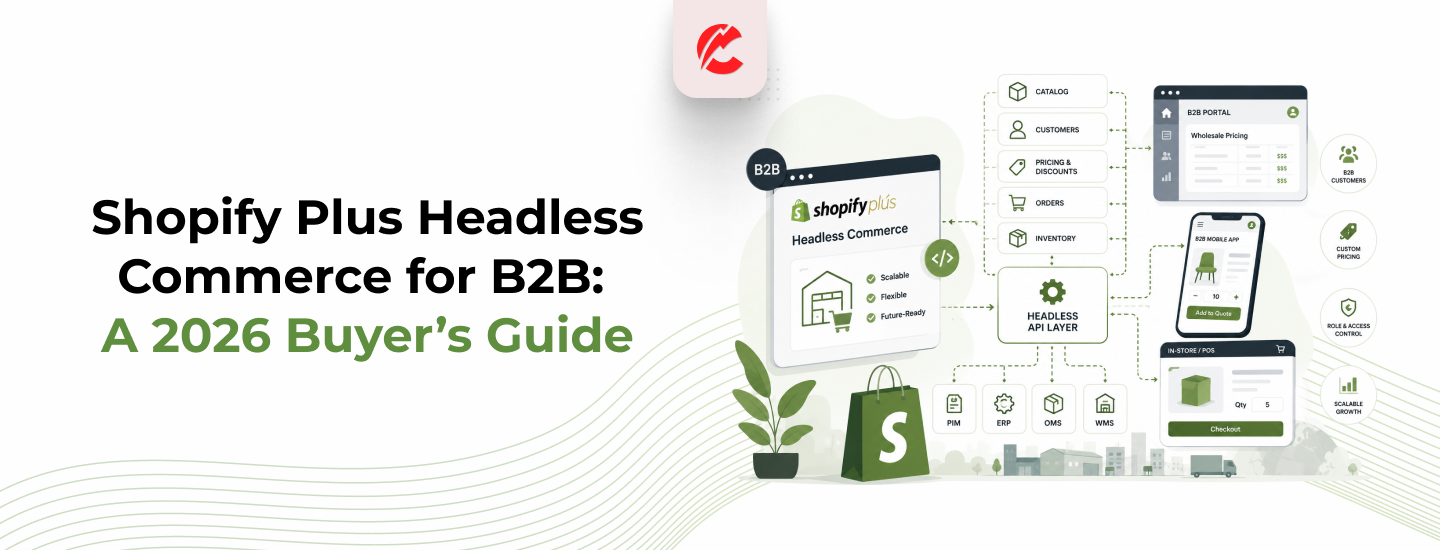
Almost every article about Shopify Plus headless commerce is written by an agency that sells headless builds, which means almost every article concludes that you probably need one. That bias shows up in subtle ways: vague “when to consider it” checklists that fit nearly any growing brand, and cost ranges quoted as starting prices that quietly become 2-3x more by the time a build ships.
This is the conversation without that bias. Native Shopify Plus has genuinely closed most of the gap that used to force a headless decision two or three years ago. For a real share of brands reading this, the honest answer is that you don’t need headless commerce — and the agencies who’ll tell you that to your face before taking your money are worth paying attention to.
Here’s what headless actually costs in 2026, who genuinely needs it, what changed on the platform this year, and a new wrinkle nobody was asking about until recently: what headless architecture means for whether AI agents can actually find and recommend your products.
What “headless” actually means on Shopify Plus
Headless commerce is an architecture decision, not a Shopify product tier. On a traditional Shopify Plus store, the frontend (what shoppers see) and backend (products, cart, checkout, customer data) are bound together through Liquid themes, and everything ships from Shopify’s own servers.
In a headless build, you split the two apart. Shopify Plus keeps running the backend exactly as before. The storefront becomes a separate application — built in Shopify’s own Hydrogen framework, or in Next.js, Remix, or Nuxt — that talks to Shopify through the Storefront API. That separation is what unlocks full design freedom, custom URL structures, and the ability to mix in best-of-breed tools. It’s also what introduces the cost and ongoing complexity the rest of this piece covers honestly.
Traditional Plus vs. headless Plus, side by side
-
Time to launch: 4–12 weeks on traditional Plus. 4–14 months on a headless build, depending on scope.
-
Build cost: $20,000–$80,000 for a traditional theme-based build. $80,000–$400,000+ for headless, depending on complexity.
-
Time to change the UI: Hours on a theme, since a marketing manager can edit a landing page directly. Days to weeks on headless, since most changes become a development task.
-
Page builders (Shogun, PageFly, etc.): Work natively on themes. Generally don’t work on headless — developers build everything by hand or through a dedicated visual layer.
-
Best fit: Marketing-led teams on traditional Plus. Dev-led teams with ongoing engineering capacity on headless.
The most underweighted line on that list is the UI-change one. It’s easy to discount in a sales conversation and expensive to discover six months into a headless build, when every landing-page tweak now requires a sprint instead of fifteen minutes in the theme editor.
The real triggers, not the generic ones
Most “why go headless” lists could apply to almost any growing brand, which makes them useless for an actual decision. These are the specific, checkable situations where native Shopify Plus genuinely can’t get you there:
-
Pricing logic that lives outside Shopify. If prices live in an ERP and change daily based on contracts, currency rules, or negotiated terms, pre-syncing them into Shopify catalogs eventually breaks. A headless storefront can call the ERP at cart-time and resolve the real price live; Shopify still processes the order.
-
Multiple distinct portals from one backend. A buyer storefront, a sales-rep ordering tool, and a dealer or customer-service portal, each with different visibility rules, is something headless can build cleanly from a single backend. Native Plus covers some of this, not all of it.
-
Catalog complexity past native limits. Shopify Plus B2B supports a meaningful number of catalogs per company location — generous for most businesses, limiting if pricing runs on dozens of negotiated catalogs per account with conditional visibility.
A useful rule of thumb
If two of the three triggers above genuinely apply to your business, the headless conversation is worth having. If none apply, native Plus is very likely enough — and any agency worth working with should be willing to say so before you spend six figures finding out the hard way.
There isn’t one “headless build” — there are three
Hydrogen + Oxygen
Shopify’s own React framework, hosted on Shopify’s edge network at no extra hosting cost. Tightest integration with Shopify’s own roadmap and the safest default if the storefront is the whole product and the team is committed to staying on Shopify long-term.
Bring your own stack (Next.js, Remix, Nuxt)
Hosted separately on Vercel or Netlify. A larger talent pool, easier integration with content-heavy CMS tools like Sanity or Contentful, and the better fit if the team already knows the framework or the site leans heavily on editorial content rather than pure commerce.
Hybrid — the option most comparisons skip
Keep Liquid for most of the store and go headless only on the specific parts that need it — typically a sales-rep portal, a B2B account dashboard, or one custom cart experience. Lower build cost, lower monthly burn, and marketing keeps using the theme editor everywhere else. For a mid-market brand tempted by full headless but unable to justify the cost, this is very often the smartest real answer, and it’s the option least likely to come up in a sales pitch.
What headless actually costs in 2026
One-time build cost scales with scope: a minimal headless build runs roughly $80,000–$120,000 over 4–6 months; a standard build with custom catalogs and one ERP integration runs $120,000–$200,000 over 6–9 months; a complex build with multiple portals and a contract-pricing engine runs $200,000–$400,000+ over 9–14 months.
The number most cost breakdowns leave out is the monthly run-rate after launch:
That works out to roughly $62,000–$208,000 per year on top of the original build — a three-year total cost of ownership in the $300,000–$800,000 range for a real operation. The ROI math has to clear that bar. For brands above roughly $5 million in annual revenue with a genuinely differentiated buyer experience, it usually does. Below that, native Plus or the hybrid approach is almost always the smarter call.
What changed in 2026
Two platform-level changes from this year materially affect this decision, and any headless guide written before mid-2026 likely predates both.
The Customer Account API replaced legacy customer accounts
Shopify deprecated the old customer authentication system in early 2026. Headless builds completed before that point are running on a system Shopify no longer supports. Migration to the new Customer Account API, which uses OAuth 2.0 and supports passwordless email login, typically takes 4–8 weeks. If an existing headless build predates this change, that migration is the first thing worth auditing — before anything else on this list.
Shopify’s Spring ’26 Edition added agentic commerce as a new architecture variable
In June 2026, Shopify shipped Agentic Storefronts, Shopify Catalog, and the Universal Commerce Protocol — infrastructure that makes eligible Shopify stores discoverable and transactable inside ChatGPT, Microsoft Copilot, and Google’s AI tools by default. This adds a genuinely new factor to the headless decision that didn’t exist when most existing headless guides were written.
The new wrinkle: does headless help or hurt AI discoverability?
The honest answer is more nuanced than either side of this argument usually admits. Shopify Catalog syndicates product data to AI channels based on the product catalog itself, not the theme rendering it — so a Liquid-themed store and a headless store are both eligible for the same Catalog-based discovery, in principle.
Where it gets more specific: AI agents that discover products via direct API access read structured catalog data regardless of frontend. But agents that fall back to crawling a page directly — which still happens — run into real structural friction with traditional Liquid themes: slower time-to-first-byte, JavaScript-dependent rendering, and less direct control over the structured data agents parse. Properly built headless storefronts, particularly on Hydrogen, tend to have an architectural edge here specifically because server-side rendering and clean API responses are easier to control deliberately.
What this means in practice
Agentic readiness alone is not, on its own, a strong enough reason to go headless — a well-optimized Liquid theme with complete product data and proper schema markup can perform perfectly well in Shopify Catalog. But it is a legitimate secondary factor to weigh if a brand is already close to the headless decision for other reasons, since Hydrogen’s architecture is somewhat more naturally suited to fast, structured responses for both human shoppers and AI agents.
Shopify Plus vs Headless Commerce: Decision Guide
| Stay on Traditional Shopify Plus If | Headless Is Worth Evaluating If |
|---|---|
| Native Plus features plus a few apps already express your buyer/shopper experience. | Revenue is above roughly $5M and growing. |
| Your team is marketing-led, not dev-led. | The storefront experience is a genuine competitive edge, not a cost center. |
| Your roadmap is more about catalogs and faster campaigns, not a completely different shopping UX. | You have or will hire at least one dedicated frontend engineer. |
| You don’t have engineering capacity to maintain a headless stack after launch. | Pricing logic, multiple portals, or catalog complexity outgrow native Plus limits. |
Consider the hybrid path specifically when native Plus gets roughly 80% of the way there, but one portal or workflow genuinely needs custom architecture — it keeps the cost profile close to traditional Plus while still solving the actual problem.
The part worth saying plainly: native Shopify Plus has improved substantially since 2023. B2B companies, locations, catalogs, price lists, payment terms, and draft orders are now mostly native capabilities that used to require a custom build. A meaningful share of brands that would have gone headless two or three years ago genuinely don’t need to anymore.
Where to start
The right first step isn’t a build proposal in either direction — it’s an honest assessment of which column above actually describes the business, run before any code gets written. That assessment is exactly what determines whether the right move is optimizing the Shopify Plus setup already in place, a hybrid build on the one workflow that needs it, or a genuine headless project with a clear ROI case behind it.
That’s the conversation we have with clients before recommending anything. Get in touch for a free consultation, or explore our Shopify development services to see how we approach platform and architecture decisions like this one.