
The ecommerce industry is moving toward faster, more flexible, and highly personalized shopping experiences. Traditional Shopify themes provide an excellent foundation for many businesses, but brands looking for complete control over storefront design, performance, and customer experience are increasingly exploring Shopify Hydrogen and Oxygen.
Shopify Hydrogen and Oxygen represent Shopify’s modern headless commerce approach, allowing developers and brands to create custom storefront experiences while still using Shopify’s powerful backend infrastructure.
In 2026, Shopify Hydrogen has evolved beyond a simple React framework into a broader toolkit for building high-performance commerce experiences, while Oxygen provides Shopify-native hosting optimized for Hydrogen storefronts.
This guide explains what Shopify Hydrogen and Oxygen are, how they work together, their SEO benefits, advantages, limitations, and whether your ecommerce business should consider adopting them.
What Is Shopify Hydrogen?
Shopify Hydrogen is Shopify’s development framework for creating custom headless storefronts.
Unlike traditional Shopify themes that rely on Liquid templates, Hydrogen allows developers to build storefronts using modern web technologies such as React and Shopify’s commerce APIs.
A headless Shopify setup separates:
- Frontend experience — website design, user interface, animations, interactions
- Backend commerce system — products, inventory, payments, orders, customer data
This separation gives brands more freedom to create unique shopping experiences.
With Shopify Hydrogen, businesses can build:
- Custom ecommerce websites
- Interactive product experiences
- Advanced merchandising experiences
- Omnichannel shopping interfaces
- Personalized storefronts
Shopify provides Hydrogen tools, components, and utilities designed specifically for commerce applications.
What Is Shopify Oxygen?
Shopify Oxygen is Shopify’s managed hosting platform designed for Hydrogen storefronts.
When developers create a Hydrogen storefront, Oxygen provides the infrastructure needed to deploy and run that website globally.
Instead of managing servers, businesses can use Shopify’s hosting environment optimized for headless commerce.
Oxygen helps with:
- Fast global content delivery
- Easy Hydrogen deployments
- Shopify-native infrastructure
- Scalable storefront hosting
Shopify’s official workflow allows developers to create a Hydrogen storefront, connect it with Shopify, and deploy it directly to Oxygen.
How Shopify Hydrogen and Oxygen Work Together
Think of Hydrogen and Oxygen as two connected parts of the same ecosystem.
Shopify Hydrogen = Storefront Development
Hydrogen controls:
- Website design
- Components
- User experience
- Storefront functionality
- Frontend performance
Shopify Oxygen = Storefront Hosting
Oxygen manages:
- Deployment
- Hosting infrastructure
- Global delivery
- Runtime environment
Together they create a complete headless Shopify solution.
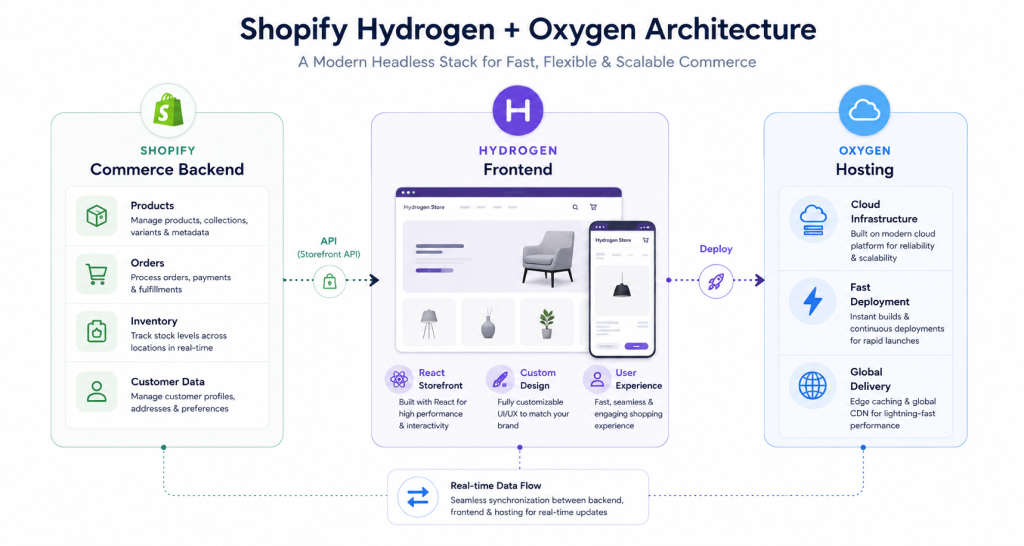
The architecture looks like this:
Customer → Hydrogen Storefront → Shopify APIs → Shopify Commerce Backend
The customer sees a custom-built website, while Shopify manages products, checkout, payments, and order processing.
Shopify Hydrogen vs Traditional Shopify Themes
Many merchants ask whether they should use Hydrogen or stay with Shopify themes.
The answer depends on business goals.
Shopify Themes
Traditional Shopify themes are best for:
- Small and medium businesses
- Quick store launches
- Limited customization needs
- Lower development budgets
Advantages:
- Easy setup
- Large theme ecosystem
- Less technical maintenance
- Faster implementation
Shopify Hydrogen
Hydrogen is better suited for:
- Enterprise brands
- Shopify Plus merchants
- Businesses needing unique experiences
- Brands requiring advanced performance optimization
Advantages:
- Complete frontend control
- Custom user experiences
- Better flexibility
- Advanced development possibilities
However, Hydrogen requires stronger technical expertise because businesses maintain a separate frontend application.
SEO Benefits of Shopify Hydrogen and Oxygen
A common question is:
Is Shopify Hydrogen good for SEO?
Yes, when implemented correctly.
Headless Shopify does not automatically improve rankings, but it provides opportunities for better technical SEO.
1. Faster Website Performance
Page speed affects user experience and can influence search performance.
Hydrogen allows developers to optimize:
- JavaScript loading
- Image delivery
- Page rendering
- Core Web Vitals
A faster ecommerce website can improve engagement metrics such as:
- Lower bounce rates
- Longer sessions
- Higher conversion rates
2. Better User Experience
Modern SEO focuses heavily on user satisfaction.
Hydrogen allows brands to create:
- Faster navigation
- Smooth transitions
- Interactive product pages
- Personalized shopping journeys
Better user experience can support stronger organic performance.
3. Advanced Technical SEO Control
With Hydrogen, developers have greater control over:
- Metadata
- Structured data
- URL architecture
- Canonical tags
- Schema markup
- Internal linking
This flexibility is valuable for large ecommerce websites with thousands of products.
Shopify Hydrogen Features in 2026
Modern Hydrogen development includes tools focused on improving commerce development speed and flexibility.
Key capabilities include:
Shopify Storefront API Integration
Hydrogen connects directly with Shopify’s APIs to retrieve:
- Products
- Collections
- Customer information
- Cart data
- Checkout experiences
React-Based Development
Developers can create reusable components and highly customized storefront interfaces.
Commerce Optimized Components
Hydrogen includes tools designed specifically for ecommerce functionality.
Flexible Architecture
Recent Hydrogen updates have moved toward a more flexible toolkit approach, allowing commerce functionality to work across different development environments.
Benefits of Shopify Hydrogen and Oxygen
1. Complete Design Freedom
Traditional themes have limitations.
Hydrogen allows brands to create completely customized storefronts without being restricted by theme structures.
Examples:
- Luxury shopping experiences
- Product configurators
- Interactive storytelling pages
- Custom shopping journeys
2. Improved Scalability
Large ecommerce brands often need:
- Multiple storefront experiences
- International websites
- Custom applications
- High traffic handling
Hydrogen provides an architecture designed for advanced ecommerce requirements.
3. Better Omnichannel Opportunities
Headless commerce makes it easier to connect Shopify products with:
- Mobile applications
- Digital experiences
- Custom marketplaces
- Interactive platforms
4. Future-Ready Commerce Architecture
As ecommerce moves toward AI shopping, personalization, and connected experiences, flexible frontend systems become increasingly valuable.
Hydrogen gives brands the ability to build experiences beyond traditional storefront limitations.
Challenges of Shopify Hydrogen and Oxygen
Despite its advantages, Hydrogen is not the right solution for every Shopify merchant.
Higher Development Costs
Hydrogen requires developers with experience in:
- React
- APIs
- Modern frontend frameworks
- Deployment workflows
Initial development investment is usually higher than using a Shopify theme.
More Technical Maintenance
A traditional Shopify theme requires less ongoing management.
With Hydrogen, businesses need to manage:
- Frontend updates
- Code changes
- Performance monitoring
- Developer workflows
App Compatibility Considerations
Some Shopify apps are designed specifically for theme-based stores.
Headless implementations may require custom integrations.
Before migrating, businesses should evaluate essential apps including:
- Reviews
- Loyalty programs
- Subscription tools
- Marketing automation
Who Should Use Shopify Hydrogen and Oxygen?
Shopify Hydrogen and Oxygen are ideal for:
Enterprise Ecommerce Brands
Large businesses needing custom experiences and scalability.
Shopify Plus Merchants
Companies investing heavily in brand differentiation.
Growing Brands With Development Resources
Businesses wanting complete control over their ecommerce experience.
International Ecommerce Companies
Brands managing multiple markets, languages, and storefront experiences.
Who Should Avoid Shopify Hydrogen?
Hydrogen may not be necessary for:
- New Shopify stores
- Small businesses
- Stores using standard themes successfully
- Merchants without technical resources
For many businesses, optimizing an existing Shopify theme can provide excellent results without the complexity of headless commerce.
Shopify Hydrogen and Oxygen Cost Considerations
The cost depends on:
- Development requirements
- Store complexity
- Custom features
- Maintenance needs
Expenses may include:
- Frontend development
- Design implementation
- Custom integrations
- Ongoing technical support
While Oxygen is Shopify’s hosting solution for Hydrogen storefronts, the largest investment is usually development and maintenance.
Final Thoughts: Is Shopify Hydrogen and Oxygen Worth It in 2026?
Shopify Hydrogen and Oxygen provide a powerful solution for brands that need more than a traditional ecommerce theme can offer.
They deliver:
- Complete frontend flexibility
- High-performance storefront possibilities
- Advanced SEO control
- Scalable headless commerce architecture
However, Hydrogen is not a universal upgrade for every Shopify store.
Businesses should choose Hydrogen when they need custom experiences, advanced performance optimization, and long-term ecommerce flexibility.
For growing brands with ambitious digital strategies, Shopify Hydrogen and Oxygen represent one of the strongest approaches to building a future-ready ecommerce storefront in 2026.