
Custom Ecommerce Development Guide: Everything You Need to Know in 2026
The ecommerce industry is growing rapidly, and businesses are no longer competing only on products or pricing. Today, customers expect personalized shopping experiences, faster performance, seamless checkout, and unique brand interactions.
While ready-made ecommerce platforms help businesses launch quickly, many growing companies eventually require more flexibility, advanced features, and better control. This is where custom ecommerce development becomes essential.
A custom ecommerce website allows businesses to create a digital store specifically designed around their goals, customer expectations, operational processes, and long-term growth plans. Unlike template-based stores, custom ecommerce solutions provide complete control over design, functionality, integrations, and scalability.
This complete guide explains what custom ecommerce development is, its benefits, development process, key features, costs, technologies, and how businesses can choose the right approach.
What Is Custom Ecommerce Development?
Custom ecommerce development is the process of designing and building an online store according to a business’s unique requirements. Instead of using limited templates or pre-built features, developers create customized solutions that match specific business workflows and customer needs.
A custom ecommerce website can include:
- Unique website design and branding
- Customized product management systems
- Personalized shopping experiences
- Advanced search and filtering
- Custom payment integrations
- ERP and CRM integrations
- Automated inventory management
- AI-powered recommendations
- Mobile-first shopping experiences
Unlike standard ecommerce platforms, custom development gives businesses more control over both frontend experiences and backend operations.
For example, a fashion brand may need virtual try-on features, while a B2B company may require bulk ordering, custom pricing rules, and account-based purchasing. A custom ecommerce solution can support these specific requirements.
Why Do Businesses Need Custom Ecommerce Development?
1. Create a Unique Brand Experience
Modern customers interact with thousands of online stores. A generic template can make your business look similar to competitors.
Custom ecommerce website development helps businesses create:
- Unique layouts
- Brand-focused designs
- Interactive product pages
- Personalized customer journeys
A memorable shopping experience improves customer engagement and helps businesses build stronger brand recognition.
2. Better User Experience and Higher Conversions
User experience plays a major role in ecommerce success. Customers expect websites that are fast, simple, and easy to navigate.
Custom ecommerce solutions allow businesses to optimize:
- Navigation structure
- Product discovery
- Checkout experience
- Mobile responsiveness
- Customer personalization
Features such as smart recommendations, advanced filters, and simplified checkout can reduce purchase barriers and improve conversion rates.
3. Scalability for Business Growth
Many businesses start with basic ecommerce platforms but face limitations as they grow.
A custom ecommerce platform can be developed with future expansion in mind, including:
- Increasing product catalogs
- Higher website traffic
- Multiple warehouses
- International selling
- Multiple storefronts
This makes custom development suitable for startups planning rapid growth as well as established enterprises.
4. Advanced Integration Capabilities
Businesses often use multiple systems to manage operations, such as:
- CRM software
- ERP platforms
- Payment gateways
- Inventory management tools
- Marketing automation systems
Custom ecommerce development allows seamless integration between these systems, improving efficiency and reducing manual work.
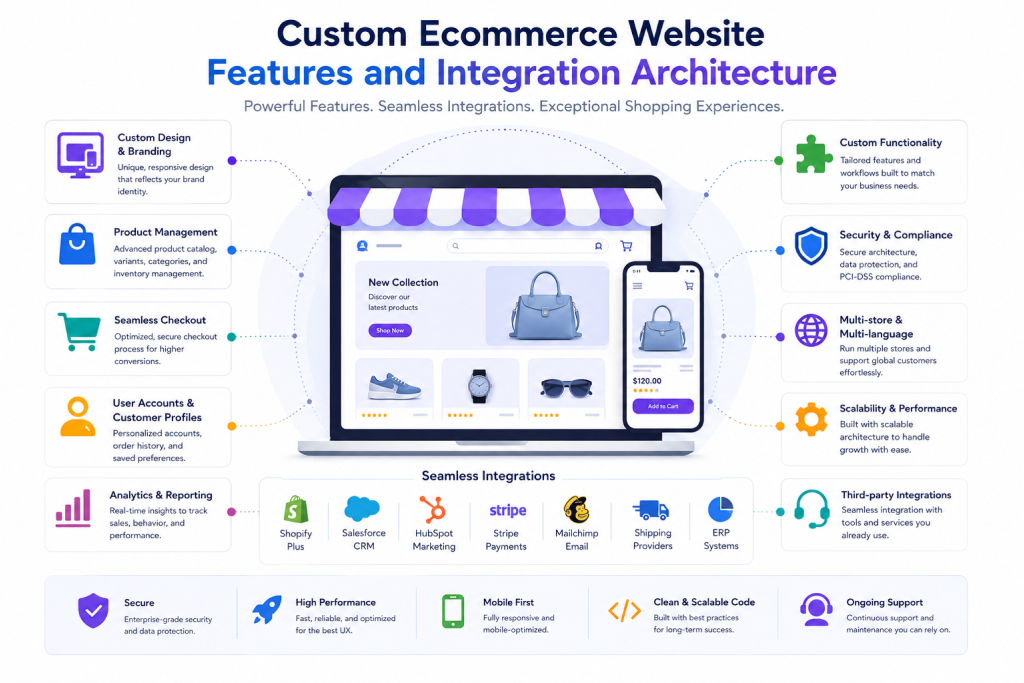
Key Features of a Custom Ecommerce Website
A successful custom online store should include essential features that improve customer experience and business operations.
1. Responsive Ecommerce Design
Since many customers shop through smartphones, mobile-friendly design is critical.
A responsive ecommerce website ensures:
- Fast loading on mobile devices
- Easy product browsing
- Simple checkout process
- Better search visibility
2. Advanced Product Search and Filtering
Customers should quickly find what they need.
Important search features include:
- Keyword search
- Category filters
- Price filters
- Brand filters
- Product comparisons
- AI-powered suggestions
Better product discovery improves customer satisfaction and increases sales opportunities.
3. Personalized Shopping Experience
Personalization has become a major ecommerce trend.
Custom ecommerce development enables:
- Personalized product recommendations
- Customer-specific offers
- Recently viewed products
- Customized email campaigns
These features help businesses deliver more relevant shopping experiences.
4. Secure Payment Gateway Integration
Security is a major concern for online shoppers.
A custom ecommerce website should support:
- Multiple payment options
- Secure transactions
- Fraud prevention
- Payment tracking
- Digital wallets
A reliable payment experience builds customer trust.
5. Efficient Inventory and Order Management
Businesses need accurate control over products and orders.
Custom ecommerce solutions can include:
- Real-time inventory tracking
- Automated stock updates
- Order processing workflows
- Shipping integration
- Customer order tracking
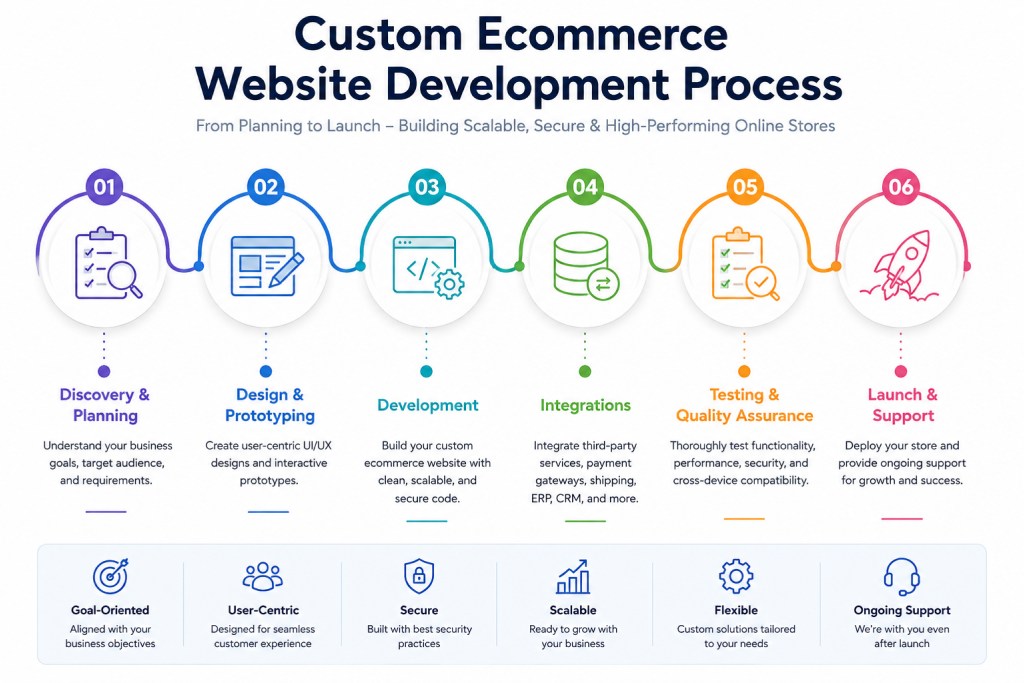
Custom Ecommerce Development Process
Building a custom ecommerce website requires proper planning and execution.
Step 1: Define Business Requirements
The first step is understanding:
- Target customers
- Business goals
- Required features
- Sales channels
- Operational challenges
A clear strategy helps create a solution aligned with business objectives.
Step 2: Select the Right Technology Stack
Developers choose technologies based on project requirements.
Common technologies include:
- Frontend frameworks
- Backend frameworks
- Databases
- Cloud hosting solutions
- Ecommerce APIs
The technology selection impacts website performance, security, and scalability.
Step 3: Design User Interface and Experience
The design phase focuses on creating an engaging customer journey.
Developers create:
- Wireframes
- Website layouts
- Product page designs
- Checkout flows
The goal is to make shopping simple and intuitive.
Step 4: Development and Customization
During development, programmers build:
- Frontend interfaces
- Backend systems
- Ecommerce functionalities
- Third-party integrations
This stage transforms designs into a fully functional ecommerce platform.
Step 5: Testing and Quality Assurance
Before launch, the website should be tested for:
- Performance
- Security
- Mobile compatibility
- Payment functionality
- User experience
Testing ensures customers receive a smooth shopping experience.
Step 6: Launch and Continuous Optimization
After deployment, businesses should continuously improve their ecommerce store through:
- Analytics monitoring
- Feature updates
- Security improvements
- SEO optimization
- Performance enhancements
Custom Ecommerce Development Cost
The cost of developing a custom ecommerce website depends on several factors:
Website Complexity
A basic custom store costs less than an enterprise ecommerce platform with advanced functionality.
Features Required
Additional features increase development effort, including:
- AI recommendations
- Mobile applications
- Custom dashboards
- Marketplace functionality
- Advanced integrations
Design Requirements
A completely unique design requires more research, UX planning, and development time.
Development Team
Costs vary depending on whether you choose:
- Freelancers
- Ecommerce development agencies
- In-house developers
A custom ecommerce project can range from a small business solution to a large enterprise platform requiring significant investment.
Latest Trends in Custom Ecommerce Development
Artificial Intelligence in Ecommerce
AI is transforming online shopping through:
- Smart recommendations
- Chatbots
- Predictive analytics
- Automated customer support
Headless Ecommerce Architecture
Headless commerce separates the frontend experience from backend commerce systems, allowing businesses to create faster and more flexible shopping experiences.
Progressive Web Apps (PWAs)
PWAs provide app-like experiences through websites, offering:
- Faster loading
- Offline functionality
- Better mobile engagement
Voice and Visual Search
Customers are increasingly using voice commands and image-based searches to discover products.
Custom ecommerce solutions can integrate these technologies to improve product discovery.
Custom Ecommerce Development vs Template-Based Ecommerce
| Custom Ecommerce Development | Template-Based Ecommerce |
|---|---|
| Fully personalized design | Limited customization |
| Better scalability | May have growth limitations |
| Advanced integrations | Basic integrations |
| Complete feature control | Fixed functionality |
| Higher initial investment | Lower starting cost |
Businesses should choose custom development when they need flexibility, unique functionality, and long-term scalability.
How to Choose a Custom Ecommerce Development Company?
Choosing the right ecommerce development partner is essential for building a scalable and high-performing online store. Consider these factors before making a decision:
Experience and Portfolio
Review the company’s previous ecommerce projects, industry expertise, and experience in building custom ecommerce solutions. CommerceBolt helps businesses develop customized ecommerce platforms focused on performance, scalability, and better customer experiences.
Technical Expertise
Ensure the development team has expertise in:
- Ecommerce platforms and customization
- API integrations
- Payment gateway solutions
- Security practices
- Performance optimization
Support and Maintenance
A reliable ecommerce partner should provide ongoing support, updates, and optimization after launch to keep your store secure and competitive.
Understanding of Business Goals
The right ecommerce development company should understand your business objectives and create solutions that improve customer experience, conversions, and long-term growth.
Final Thoughts
Custom ecommerce development gives businesses the ability to build powerful, flexible, and customer-focused online stores. While ready-made platforms may work for basic requirements, growing businesses often need customized solutions to improve user experience, manage complex operations, and stay competitive.
By investing in custom ecommerce website development, businesses gain complete control over their digital store, create better customer experiences, and build a platform ready for future growth.
Whether you are launching a new ecommerce business or upgrading an existing store, a customized ecommerce solution can become a long-term foundation for online success.